

 Latest News Real GDP growth moderates in second quarter but ‘remains robust’ – Central Bank of Malta
 Real GDP growth moderates in second quarter but ‘remains robust’ – Central Bank of Malta
It said that economic activity in the euro area average stood well below that in Malta

Written By Kevin Schembri Orland
Published on 3 August 2026
•
3 min read
Share





During the first quarter of 2026, growth in real Gross Domestic Product (GDP) moderated when compared with the preceding quarter, although it remained robust, the Central Bank said in a report.
Real gross domestic product (GDP) rose by 3.9 per cent in annual terms, following a 6.5 per cent increase in the previous quarter. Growth was largely driven by domestic demand, even after adjusting for imports, the Central Bank said in its report.
It said that economic activity in the euro area average stood well below that in Malta. “Growth was largely driven by domestic demand, even after adjusting for imports.”
As the level increase in potential output relative to the previous quarter exceeded that in GDP, the output surplus decreased.
The Central Bank said that sectoral data showed that the expansion in output was mainly driven by the sector consisting of wholesale and retail trade, repair of motor vehicles and motorcycles, transportation and storage and services related to accommodation and food service activities. “In nominal terms, compensation of employees contributed most to GDP growth.”
The Bank’s Business Conditions Index rose marginally from the preceding quarter, confirming earlier indications that economic activity continued to expand at a pace above its long-run average. The Business Conditions Index is a synthetic indicator, which includes information from a number of economic variables such as the term-structure of interest rates, industrial production, an indicator for the services sector, economic sentiment, tax revenues and private sector credit.
The Central Bank said that during the first quarter of 2026, the labour market continued to perform strongly, with both the activity and employment rates increasing. “According to the Labour Force Survey, employment growth in Malta remained stronger than in the euro area. Although the unemployment rate edged up slightly, it remained well below that in the euro area. Labour market conditions remained tight, as both the number of job vacancies and the vacancy rate increased compared with a year earlier and stood at historically high levels.”
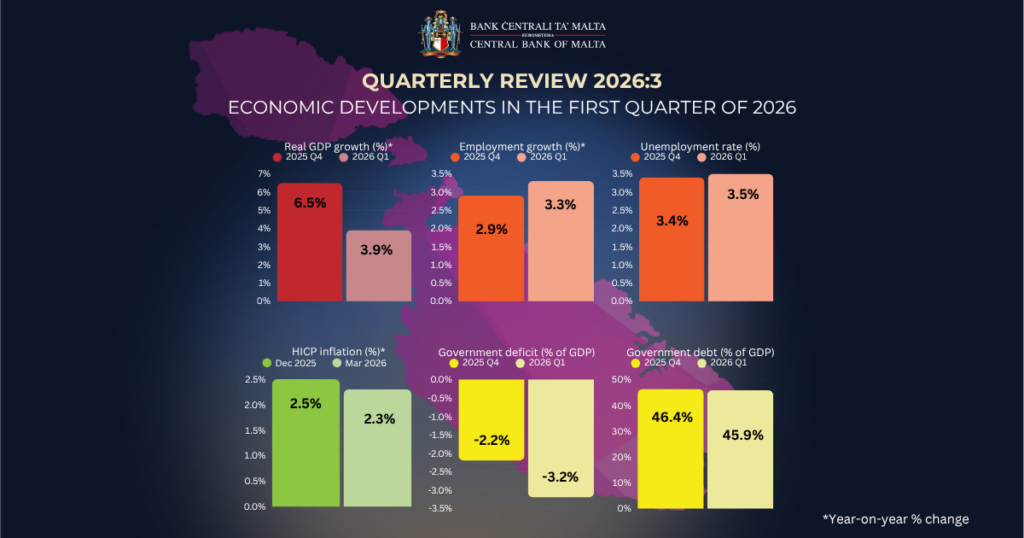
It said that consumer price inflation moderated during the first quarter of 2026. Annual HICP inflation eased to 2.3 per cent in March 2026 from 2.5 per cent in December 2025. This, the Central Bank said, was mostly driven by lower contributions from food. HICP inflation excluding energy and food increased slightly to 2.4 per cent.
“Although headline HICP inflation remained below the euro area average, underlying inflation, as measured by HICP excluding energy and food, stood above that of the euro area.”
In the first quarter of 2026, the general Government registered a larger deficit than in the corresponding period a year earlier.
“On a four-quarter moving sum basis, the deficit-to-GDP ratio increased from the fourth quarter of 2025 and stood broadly in line with the euro area average. Meanwhile, the debt-to-GDP ratio declined from the previous quarter and remained well below the corresponding euro area average.”
During the first quarter of 2026, the Governing Council of the European Central Bank (ECB) kept its key interest rates unchanged. In June, however, the Governing Council raised its key policy rates by 25 basis points in line with its commitment to ensuring that inflation stabilises at its 2 per cent medium-term target, the Central Bank of Malta noted. “The Governing Council stated that with this decision, it remained well positioned to navigate the uncertainty caused by the war in the Middle East.”
Share
Written By Kevin Schembri Orland
Kevin is a senior journalist and business correspondent at Content House. He has a passion for writing and over a decade of experience in the news media sector in Malta.

Continue Reading



Malta’s Economic Sectors