


FDI figures confirm Malta’s role as a key node within European capital structures
€5.6 billion in FDI flowed into Malta in the first half of 2025. How much stayed in the country?

Written By Robert Fenech
Published on 27 February 2026
•
5 min read
Share





Malta’s foreign direct investment (FDI) position continued to expand in the first half of 2025, underlining the country’s entrenched role within European cross-border capital structures.
According to data released by the National Statistics Office (NSO), the stock of inward FDI stood at €485.1 billion at the end of June 2025, while Malta’s outward direct investment position reached €459.2 billion.
During the first six months of the year, inward FDI flows increased by €5.6 billion, while outward flows amounted to €6.1 billion.
In simple terms, foreign companies, individuals and other entities hold €485.1 billion worth of ownership stakes and financial claims in Maltese-registered businesses. At the same time, Maltese-registered entities hold €459.2 billion in similar cross-border investments abroad.
Much of this reflects how multinational groups structure their operations. For example, an international investment firm might establish a €10 billion fund in Malta. Legally, that capital is recorded as foreign investment into Malta. If that fund then invests the €10 billion into companies in Germany, the UK or the US, it is simultaneously recorded as Maltese investment abroad.
In this way, Malta can show very large inward and outward investment positions, even if the underlying businesses operate in other countries.
The NSO emphasises that the estimates for 2023 onwards are “highly provisional”, reflecting the use of preliminary survey data and estimated reinvested earnings pending final annual reporting.
Nonetheless, the vast majority – 98.4 per cent of Malta’s inward FDI stock and 99.5 per cent of outward FDI – are classified under financial and insurance activities, reflecting Malta’s longstanding position as a jurisdiction hosting holding companies, intra-group financing vehicles, investment funds, and insurance and reinsurance structures.
The €485.1 billion inward stock figure is large relative to Malta’s GDP – just shy of €25 billion – but this is characteristic of small, open economies that host significant cross-border financial activity.
At the same time, outward FDI — totalling €459.2 billion — highlights that Malta-based financial structures are investing abroad at comparable scale. The near symmetry between inward and outward positions reinforces Malta’s intermediary role in cross-border capital flows.
In fact, outsized inward and outward positions, when compared to GDP, and a dominant role played by financial services on both sides, are also found in Luxembourg, Ireland and the Netherlands.
Effectively, the figures capture Malta’s role in international capital structuring and financial intermediation, as the data reflects the legal residence of investment vehicles rather than the physical location of underlying assets.
FDI in the real economy
The portion of inward of FDI not classified under financial and insurance activities, in the first half of 2025, amounted to €325 million.
Older statistical updates break this down further into categories like manufacturing, real estate, accommodation, transport, and ICT, but no sectoral breakdown is yet available for the period in question.
These sectors are more closely associated with employment creation, infrastructure development, and supply chain effects within the Maltese economy. Therefore, while making up a comparatively small portion of total FDI inflows, non-financial FDI plays a disproportionate role in shaping Malta’s long-term productive capacity.
However, the NSO warns against a strict division of FDI flows in two – financial and the real economy.
Speaking to MaltaInvest.mt, a representative for the agency notes that financial and insurance activities “include all financial and insurance activities, so technically it cannot be simply excluded from the total figure.”
For example, a multinational bank or insurance firm with actual operations in Malta would have any investment in its Maltese operations included in the financial figures.
An international private equity or investment firm transferring capital to a locally based financial vehicle would also be recorded as financial FDI, even if the vehicle acts as a conduit for investment into a Maltese manufacturing firm.
While almost certainly a small fraction of the total flow of capital into the country, the distinction means that FDI flows related to financial and insurance activities cannot be cleanly separated from domestic productive investment.
FDI over the years
Regardless of the exact impact financial services-related FDI has on the local economy, the €325 million inflow of capital into other sectors in the first half of 2025 is a significant sum.
For context, the entirety of 2021 saw €485 million in net inward FDI not related to financial and insurance activities, 2022 €422 million, 2023 €536 million, and 2024 €253 million.
The NSO warns that the estimate for the first six months of 2025 is in no way a projection for the full year. Nonetheless, it still eclipses the figure for 2024.
Takeaways
While the figures by themselves elude definitive conclusions about the impact on Malta’s productive capacity, they do have strategic implications.
The characteristics of the inward and outward flows of capital highlight how deeply Malta is embedded in cross-border financial structures, especially European ones, where most investment comes from and goes to. This demonstrates continued confidence in Malta’s corporate and regulatory framework.
They also point to potential risks. The heavy concentration in financial flows exposes Malta to European and global efforts to harmonise tax rates and introduce anti-tax avoidance frameworks, raising the question of the country’s resilience if its role as a base for financial structures is threatened.
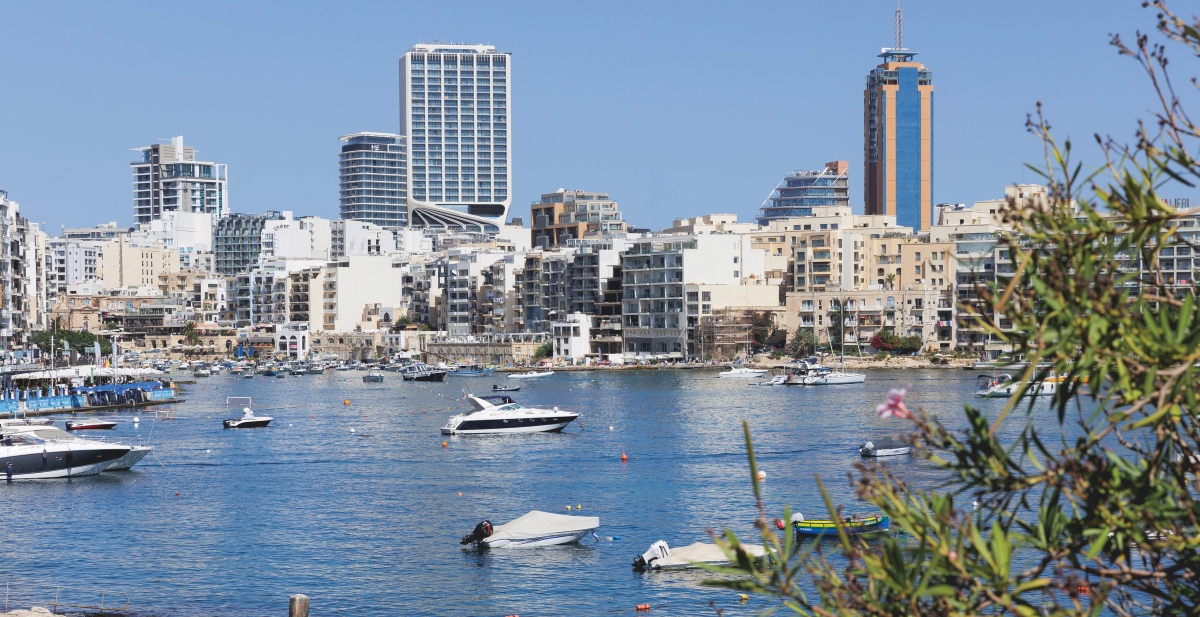
Image: St Julian's, Malta / Inigo Taylor
Share
Written By Robert Fenech
Online Business Editor
Robert is curious about the connections that make the world work, and takes a particular interest in the confluence of economy, environment and justice. He can also be found moonlighting as a butler for his big black cat.



Continue Reading



Malta’s Economic Sectors