



Trumia: Where financial tradition meets modern innovation
Blending the dependability of traditional finance with the agility of next-generation technology, fintech firm Trumia is modernising how money moves

Written By Malta Invest
Published on 4 March 2026
•
6 min read

Share





For decades, the financial world was built on stability and control. Innovation wasn’t always the priority – reliability was. Payments worked, but they rarely evolved. That is changing. Today, the industry is being reshaped by new technologies, shifting expectations and emerging players that recognise that efficiency, connectivity and user experience matter just as much as trust.
The push for instant transfers, smarter compliance and frictionless user journeys has redefined reliability. Regulation, digital currencies and real-time settlement have become the new baseline. and behind every transaction, clients now expect the same speed and transparency they enjoy from their favourite apps.
This shift favours firms that understand both sides of the equation. Trumia is one of them – a modern fintech building an ecosystem that combines the trust and governance of traditional finance with the agility of next-generation technology.
Modern finance is increasingly interconnected, yet for most businesses, it rarely feels that way. Payments move through different providers; card payments and FX through others. The result is usually complexity: multiple logins, fragmented oversight and delays that slow operations in an era that expects everything to move instantly.
Trumia was built to bridge those gaps. More than a payments provider, it offers a unified platform that connects traditional and instant payments, open banking and card services into one seamless system. Its vision is simple – to simplify how money moves while keeping the user firmly at the heart of the experience. The aim: to make money movement intuitive, transparent and immediate, without losing the security and governance that define responsible finance.
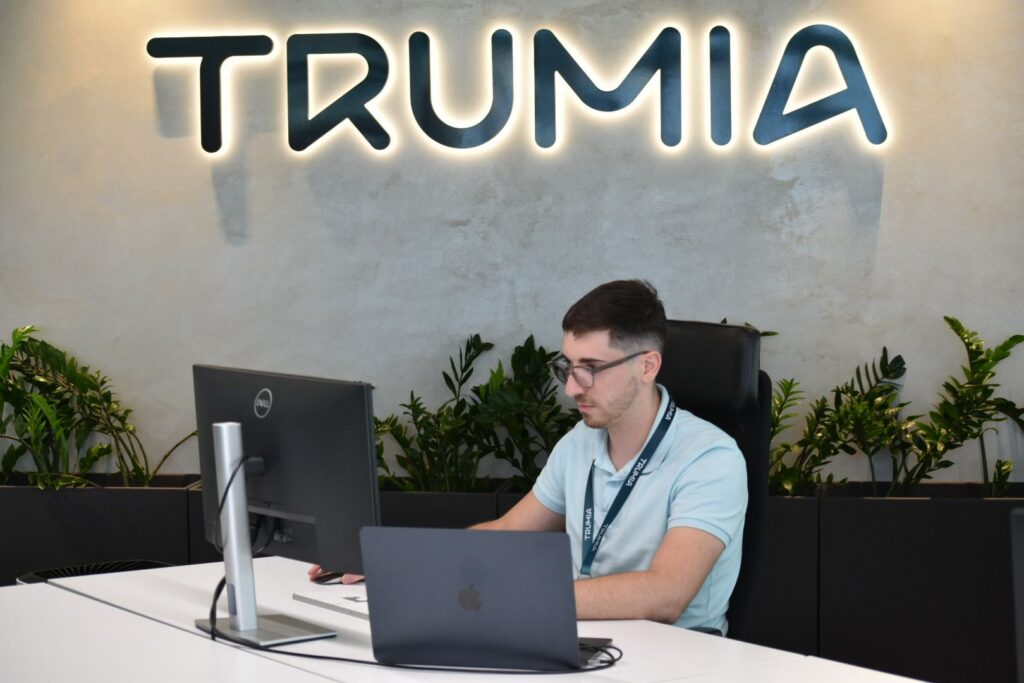
Businesses and individuals can open dedicated multi-currency accounts, send and receive payments locally or across borders, issue cards, exchange currencies, and – for those looking to go further – integrate directly via APIs. Trumia also enables smooth business-to-customer and customer-to-business payment flows, allowing merchants to receive funds or make payments directly within the same ecosystem, simplifying reconciliation and enhancing control.
What stands out isn’t just what the platform offers, but how it all works together. From account set-up to settlement, every layer – technical, operational and regulatory – is connected by design, giving clients a system that feels cohesive and effortless.
A company can track incoming and outgoing flows in real time, across currencies and jurisdictions, without waiting for intermediaries to sync data. That simplicity runs on dependable rails: Trumia’s network leverages established banking partners – both domestic and correspondent – for euro and international transfers, combining reach with reliability.
In finance, trust is personal. It’s built not just through interfaces, but through clarity – knowing that when something goes wrong, someone is accountable. After all, technology is only as powerful as the experience it delivers. Trumia was founded on the understanding that financial services should adapt to people, not the other way round.
The human layer is not an afterthought to automation; it defines reliability. The teams who design and monitor systems are also those who guide clients through onboarding and documentation. This creates a relationship built on understanding, not opacity. Businesses know why checks exist, how funds are monitored and which safeguards protect them.
This transparency builds confidence, particularly in industries often viewed as high-risk. For Trumia, it’s not just about moving money efficiently; it’s about doing so in a way that strengthens trust between people and the financial infrastructure that serves them.
Trumia ensures every automation – from instant onboarding to realtime transfers – assists human decisions rather than replaces them. For a company managing bulk payrolls, that means predictable processing and a team ready to resolve issues the moment they arise. For an individual sending funds abroad, it means clarity, transparent fees, quick updates and responsive support.
Behind every transaction stands a team of specialists who understand the financial frameworks and the complexities they bring. They navigate compliance so clients don’t have to, guiding them through the documentation needed to complete transactions with confidence.
The result is a service that moves fast without feeling mechanical, a reminder that in finance, trust still begins with human connection. Although many fintechs talk about speed and flexibility, few start by building the kind of foundation that can sustain both. That’s why Trumia’s platform is API-first. Onboarding, verification and payment reporting all run on a single, connected logic. Cloud-based architecture provides headroom: data isn’t locked in one place and performance scales as volumes grow.
Compliance is fully integrated into the transaction path. Automated KYC, AML checks and ongoing monitoring adapt to client profiles while maintaining consistent oversight. This enables Trumia to serve a wide range of sectors. You can’t be competitive without structures that keep regulators confident and processes transparent. The system is designed for that balance – risk awareness without friction, growth without blind spots.
Ultimately, real scalability comes from systems that don’t force a choice between compliance and performance. Trumia’s model maintains that balance through human oversight, regulatory depth and technical precision.
Financial services have long been overly complex for both individuals and businesses. For many, moving money across borders still feels harder than it should. Trumia’s long-term bet is that this won’t last. The sector is shifting towards leaner infrastructure, faster settlement and more transparent relationships between institutions and clients. In that landscape, simplicity will be the real advantage. For Trumia, that means focusing on fundamentals: payments that always work, controls that hold and systems that scale without losing stability.
The end game isn’t to replace traditional finance, but to improve how it connects. Each year, regulation tightens, technology accelerates and user expectations rise. The institutions that endure will be those that keep adapting without compromising on trust.
The next phase will be about intelligence – not just automating transactions, but learning from them: using data responsibly to detect patterns, reduce risk and help clients make faster, better decisions. The same infrastructure that processes payments today can already support that shift. The key is to evolve in small, deliberate steps – refining the platform, extending currency support, deepening integrations, and preparing for the moment when smart systems become the standard rather than the exception.
Trumia isn’t chasing disruption. It’s building durability – a financial model that grows stronger as the market becomes more connected. If the last decade in fintech was about speed, the next will be about trust at scale. That’s where Trumia has been heading all along.
This article was first carried in the 2026 edition of Malta Invest, the sister brand to MaltaInvest.mt and produced by Content House Group.
Share
Written By Malta Invest
This article was written by a team member at MaltaInvest.mt.

Continue Reading




Malta’s Economic Sectors