


Livestock lifts Malta’s agricultural performance in 2024 as wages jump 30%
The total output value of local agricultural produce reached €140.7 million

Written By Robert Fenech
Published on 24 September 2025
•
2 min read
Share





Malta’s agricultural sector continued to show resilience in 2024, with output and income indicators pointing to moderate but stable growth. According to provisional data published by the National Statistics Office (NSO), the sector’s performance was underpinned by stronger livestock production and sustained Government and EU financial support.
The total output value of local agricultural produce reached €140.7 million, representing a 1.6 per cent increase over 2023. Intermediate consumption – the value of goods and services used in the production process – increased only slightly, by 0.2 per cent to €87.1 million. This resulted in a gross value added of €53.6 million, up 4.1 per cent compared to the previous year.
Investment into labour and production inputs also grew. Farmers’ use of fixed capital inputs rose by 1.4 per cent to €7.2 million, while the wages paid by agricultural holdings increased significantly, by 29.7 per cent to €8.6 million.
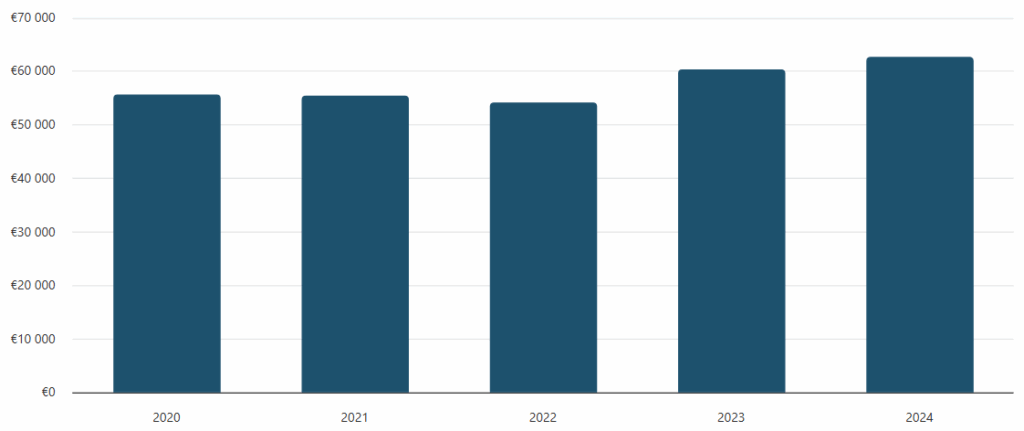
A key driver of stability in the sector remains direct financial support. In 2024, Malta’s farmers benefitted from €25.8 million in Government and EU-funded programmes, up 10.1 per cent on the previous year. As a result, the sector’s net operating surplus reached €63.6 million, while net entrepreneurial income rose to €62.6 million, both representing year-on-year increases of around 4 per cent.
Livestock gains offset crop challenges
The sector’s growth was primarily led by stronger performance in livestock products (+6.1 per cent), secondary activities such as processing (+4.5 per cent), and animal product sales (+2.8 per cent). By contrast, crop production declined by 2.6 per cent, underlining the challenges faced in cultivation due to limited arable land and resource constraints.

Meanwhile, input costs presented a mixed picture: increases were registered in energy and fuel (+0.8 per cent) and other expenses (+3.2 per cent), but these were partially offset by declines in crop cultivation costs (-5.1 per cent) and livestock feeding (-0.5 per cent).
Outlook
Although Malta’s agricultural sector represents a small share of the national economy, it plays a strategic role in food security, rural development, and land management. The sector’s continued reliance on EU and Government support highlights both its vulnerability and its potential, particularly in livestock production and in value-added activities.
For international observers, the figures demonstrate that Malta’s agricultural industry, while modest in scale, continues to modernise and attract investment aimed at improving sustainability and efficiency.
Share
Written By Robert Fenech
Online Business Editor
Robert is curious about the connections that make the world work, and takes a particular interest in the confluence of economy, environment and justice. He can also be found moonlighting as a butler for his big black cat.

Continue Reading


Malta’s Economic Sectors